
While the Andaman and Nicobar islands serve as a vital, stationary asset for projecting power in the Indian Ocean, referring to them as an unsinkable aircraft carrier ignores key military and geopolitical limitations, explains Commodore Venugopal Menon (retd).

The Beijing summit may have reduced immediate diplomatic uncertainty, but it did not resolve the deeper structural contest between the United States and China. That contest appears likely to define the coming decade, notes Varun Arya.

Beijing clearly intends to extend the China-Myanmar Economic Corridor to Bangladesh as part of its larger Maritime Belt and Road Initiative to boost its Indian Ocean presence.

China for the first time deployed a marine surveillance unit with a helicopter to carry out patrolling and observation missions near the contested islands in the South China Sea.

The Squad seeks to counter China's power assertions in the South China Sea region.

The highlight of the successful BRICS Summit was its ability to deliver a joint statement that all members, including Iran and the United Arab Emirates, embroiled in the war in West Asia, signed.

The question for the next 20 years is not whether India can become a $5 trillion or $10 trillion economy. Those are attractive targets, but the real question is whether India can create enough productive jobs, educate its children properly, make its cities liveable, and give hundreds of millions of people a substantially better life, asserts Ramesh Menon.

China has commissioned its third aircraft carrier, the Fujian, featuring advanced electromagnetic catapults, amidst rising tensions and military modernization efforts.

United States President Donald Trump has said that Iran is under close watch and a 'massive fleet' is heading towards the Gulf region.

It is plain to see that the US senate bill's real objective is to derail India's time-tested strategic partnership with Russia, points out Ambassador M K Bhadrakumar.

Usha Vedasalam completed the Kailash Mansarovar Yatra just a week before the devastating floods in Nepal. This is her account of the pilgrimage.

'The valley is around 16 km from the Nepal border, and it took just 8-10 minutes for the ice and rocks to reach the Nepal border. You can imagine how fast it must have travelled!'

For the foreseeable future, the most likely outcome remains continuation of the status quo. Taiwan will remain self-governing without formally declaring independence, while China continues to apply sustained pressure short of war, predict Krishnan Srinivasan and Manoj Mohanka.
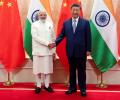
'China's basic purpose of taking the Shaksgam Valley was access to the Indian Ocean.'

Notwithstanding the economic complementarities and the host of agreements for deepening economic relation on a host of areas, both sides share common viewpoints on the foreign policy domain and seek common grounds to serve as a counterweight to China, notes Dr Rajaram Panda.

The top diplomats of Quad nations on Friday denounced as "inadmissible" any use or threat of use of nuclear weapons in the Ukraine war and strongly opposed any "unilateral actions" that seek to change the status quo in the South and East China Seas, a region that has witnessed increasing Chinese military offensive.

According to www.budgetyourtrip, Asia is home to some of the world's priciest travel destinations.
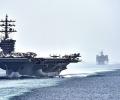
Which are the world's most vital straits, important to shipping?

Ever since the Quad started taking shape in 2007, China has been saying that the four-member grouping will be bound to fail. But much to the chagrin of Beijing, it picked up pace in the recent years emerging as a premier strategic group especially challenging China's assertiveness in the disputed South China Sea.

Beijing has been wary of Sanae Takaichi's efforts to boost Japan's military profile since taking office six months ago, points out Dr Rajaram Panda.

US Vice-President J D Vance's unexpected phone call to Prime Minister Narendra Modi on August 8 has ignited speculation about a potential diplomatic overture, possibly seeking India's support amidst the escalating US-Iran conflict and a shifting global power landscape, suggests Ambassador M K Bhadrakumar.

For India, the guiding principle should remain clear: Engage Bangladesh as a sovereign nation and society rather than through the prism of any individual leader or political party, suggests Manoj Mohanka.

China and Pakistan concluded their strategic dialogue, reiterating their opposition to unilateral actions in South Asia and discussing Kashmir, Afghanistan, and trilateral cooperation.

The US Trade Representative's office removed a social media post featuring a map of India that showed the entire region of Jammu and Kashmir, including Pakistan-occupied Kashmir, as well as the Aksai Chin region as part of Indian territory.
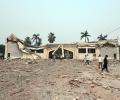
'We won not (only) because we were able to carry out long-range precision strikes.' 'That is, of course, one of the reasons but we had better situational awareness about what's happening than Pakistan.'

United States President-elect Donald Trump's plan to overhaul the government with a new department headed by tech billionaire Elon Musk and Indian-origin entrepreneur Vivek Ramaswamy will be a biggest threat for China as it has to compete with far more efficient US political system, a policy advisor to the Chinese government said.

The agreement was to disengage from remaining standoff sites along the Line of Actual Control (LAC), two days before a meeting between Chinese President Xi Jinping and Prime Minister Narendra Modi on the sidelines of the BRICS Summit.
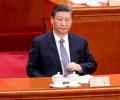
China, which is the second highest spender on defence after the United States, has allocated 1.67 trillion yuan (about USD 232 billion) for defence spending.

Successful interceptor, anti-ship, MIRV and hypersonic technology tests have strengthened India's position among a select group of advanced missile powers.
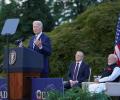
United States President Joe Biden was caught on a hot mic telling leaders of the Quad nations that China was testing them, thus reflecting upon the American seriousness of the emerging Chinese threat.

The trigger that led Japan and the Philippines to ink the deal was because of the deteriorating security situation in the South China Sea. China's coast guard increased the frequency and intensity of incursions into Philippine waters, provoking the Philippines to take countermeasures to deter China, explains Dr Rajaram Panda.

Experts' worries intensified after Pakistan commissioned its first Chinese-built Hangor-class submarine, PNS Hangor, last month.
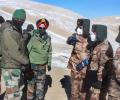
Lou also spoke about China's tensions with neighbouring countries without directly mentioning the eastern Ladakh border standoff with India since May 2020 which resulted in the Galwan Valley clash in June of that year.
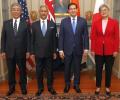
The Quad grouping has called for bringing the perpetrators, organisers and financiers of the Pahalgam terror attack to justice without any delay and urged UN member nations to extend cooperation for it.
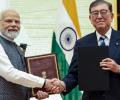
India and Japan have unveiled a comprehensive framework to boost their defence cooperation in response to security challenges, particularly concerning China's increasing military presence in the East and South China Seas.

The falling Total Fertility Rate offers India a chance to become the Pandavas -- fewer in number, but each citizen genuinely empowered, educated, and capable of contributing to a civilisation worth building, asserts Amberish K Diwanji.
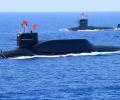
China has delivered a second advanced submarine to Pakistan, part of a larger deal to bolster the South Asian nation's naval capabilities in the Indian Ocean. The move underscores China's growing influence in the region and its strategic partnership with Pakistan.

China is engaged in hotly contested territorial disputes in the South and East China Seas. Beijing has also made substantial progress in militarising its man-made islands in the past few years, which it says it has the right to defend.

If Beijing succeeds in this multipronged effort to challenge the current dominant power, it will have not just economic but political and security consequences. There is no let-up in the South China Sea nor any de-escalation moves on the India-China border. This portends to ominous signalling from Beijing, observes China expert Srikanth Kondapalli.

The 'rescue' operation occurred within kilometres of Iran's underground tunnel complex at Isfahan, assessed by the IAEA and US intelligence as holding a substantial portion of the country's 60 per cent enriched uranium stockpile. Retired senior US military officers have highlighted that the mission's footprint -- hundreds of special operators, multiple heavy-lift aircraft deep inside Iran -- appears outsized for recovering a single airman. Prem Panicker continues his must read blog on the Iran War.
